Couples & Sex Therapist in Seattle
You may be having the same fight over and over, feeling more like roommates, trying to rebuild trust, or struggling with sex and intimacy. I help couples understand the stuck pattern between them and find a different way forward.
Couples Therapy
For couples caught in the same fight, feeling distant, or trying to rebuild trust.
You can love each other and still feel stuck in a pattern neither of you knows how to change. Couples therapy helps you slow down what happens between you, understand what sits underneath the conflict, and find a more connected way of responding to each other.
Sex Therapy
For couples and individuals navigating desire, pain, anxiety, or sexual concerns.
Sex can become complicated even in otherwise loving relationships. As an AASECT Certified Sex Therapist, I help couples and individuals understand what’s getting in the way of intimacy and build a sex life that feels more connected, comfortable, and genuinely wanted.
You are welcome here, just as you are.
I’m Audrey, a therapist, partner, and parent. I grew up in the PNW and have always been drawn to real, heartfelt conversations—which feels especially fitting since Hart is my middle name.
In therapy with me, you can expect warmth, curiosity, directness, humor, and a willingness to talk about the things that are often hardest to say out loud.
I’m a white, cisgender woman who is married to a man. Identity is a big part of the work I do with clients, so if you’d like referrals for therapists with different identities, please let me know and I’ll do my best to pass some along.
I live in Seattle with my husband, our daughter born in 2026, and our dog Kevin. Outside of work, I love backpacking year-round, reading all sorts of books, listening to storytelling podcasts, and jumping into the ocean!

My Practice
Location: Madrona neighborhood in Seattle and virtual throughout Washington
Sessions: Typically 90 minutes every other week, but flexible to do 50 minutes weekly
Fee: $335 / 90 minutes or $185 / 50 minutes
Availability: Tuesdays & Wednesdays, 9am–5pm
My Credentials
AASECT Certified Sex Therapist
Licensed Marriage & Family Therapist (LMFT), Washington
MA, Marriage & Family Therapy — Antioch University
BA, Geology & Education — Bowdoin College
What It’s Like to Work With Me
Warm & Relational
I’m not a blank-slate therapist. I’ll be honest with you, ask direct questions, and gently challenge you when I think it will help. There is room for laughter, tears, and moments of joy too!
Specialized in Sex
I’m an AASECT Certified Sex Therapist with extensive specialized training in sex and sexuality. Intimacy, desire, and relationship patterns are all things we can talk about openly!
Direct & Human
I’ll be honest with you, ask the questions that matter, and name what I’m noticing. I also bring warmth, humor, and a real human presence into the room.
Check out the Office & Meet Kevin
The Office
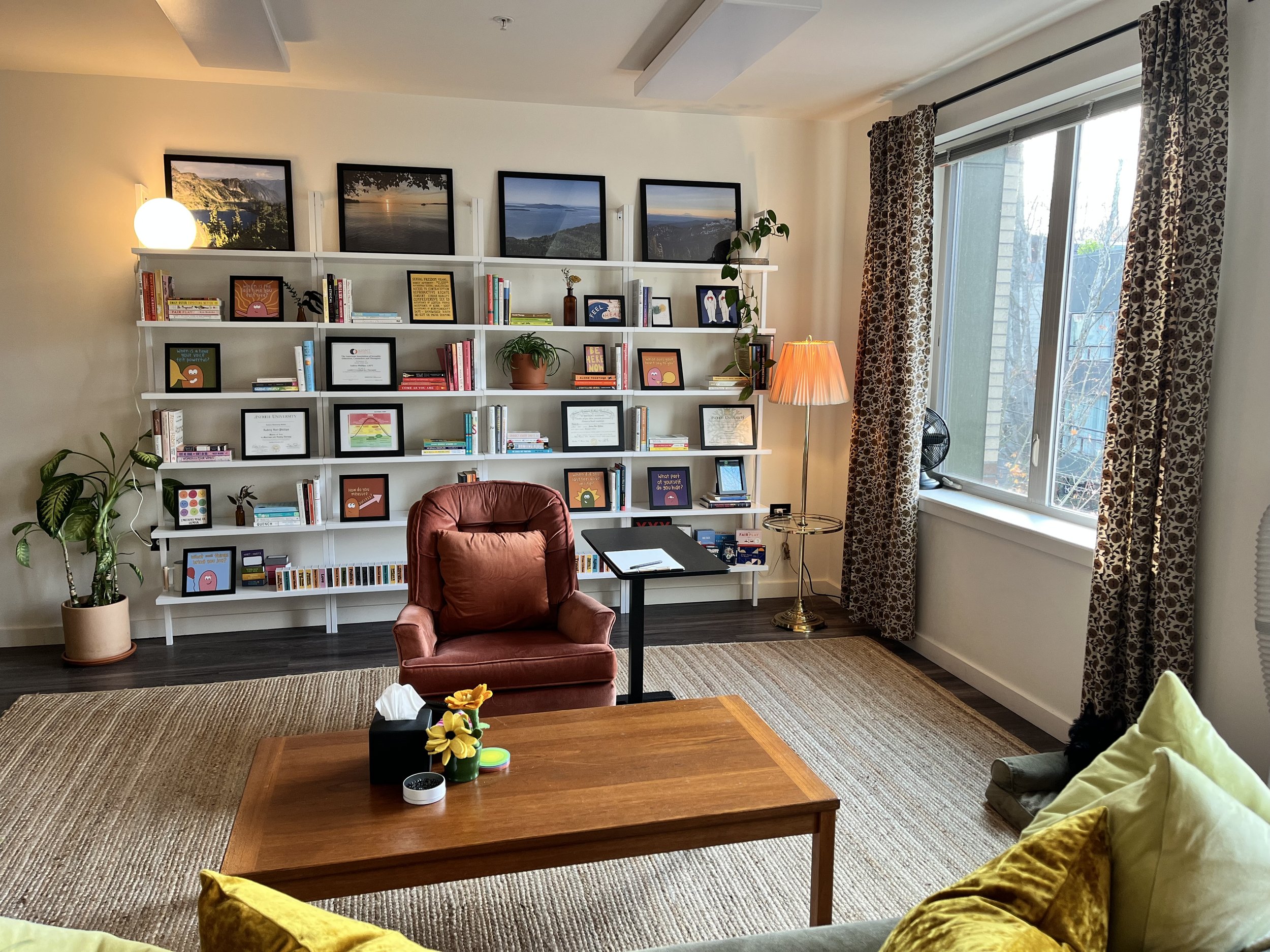
My office is warm, comfortable, and intentionally a little more living room than clinical space. I want it to feel like somewhere you can settle in, exhale, and have the conversations that might feel harder anywhere else.
Meet Kevin
Kevin is my dog and an occasional presence around the office. He brings a little extra personality to the space—and takes his role as unofficial therapy-dog-adjacent coworker very seriously.